


Ryan Holiday’s ‘The Obstacle Is the Way’ is one of those books that landed on my bedside table at exactly the right time.
It’s rooted in Stoic philosophy, mainly the teachings of Roman emperor Marcus Aurelius.
The core idea is simple: the thing blocking you is probably the thing that will grow you the most.
Here are eleven lessons from the book that I use almost daily:
1. See things as they are, not as you fear them to be.
We add layers of panic and scary narratives to stuff that happens to us. But it’s ALL mind-created stuff. WE add the fear and the panic. YOU.
Rockefeller watched the 1857 financial crash as a young clerk and while everyone around him panicked, he studied it. He stripped the emotion out and looked at the situation with clean eyes, making him a fortune.
When something ‘bad’ happens to me, which they do often, I take a breath and look at it objectively. This drains the pressure, helping me to see a logical next step.
2. The obstacle IS the way.
The thing standing between you and what you want is the thing you need to accept, and USE to your advantage.
Don’t let it run you over. Climb onto that sucker and let it carry you, all the way to Winville, Ohio.
Marcus Aurelius wrote that the impediment to action advances action. I’ve come back to this idea more than any other in the book, because it flips the entire way you look at difficulty.
What if the job you lost forces you to build something of your own?
Or the relationship that ended prompts you to rethink how you interact with others.
The rejection from a publisher makes you rewrite the book until it’s ten times better.
The problem isn’t in the way. It IS the way.
How different might life look if you saw EVERY challenge through this lens?
3. Steady your nerves as your number 1 strategy.
You will never control what happens to you, but you can always control HOW you respond.
The practice is catching yourself in the moment of reaction and choosing to observe instead of spiralling.
This takes daily practice, and I’m still improving, but remaining calm is the most absolute life skill.
4. Get moving before you’re ready.
I think about this every time I catch myself distracting myself with bullshit from the things I know are worth doing.
The right moment never arrives. You start messy, you start feeling odd, you start before you’re ready, and the feeling of ‘readiness’ shows up once you’re already moving.
Expect this, and you will be fine, as long as you freaking MOVE.
5. Focus ONLY on what you can control.
Epictetus said some things are up to us, and most things aren’t. Where we direct our attention is one of the most underrated tools we have as happy humans.
Wasting energy on stuff we can’t change is where most of our suffering lives. It really gets you nothing but frayed nerves.
I spent years worrying about things I had little to no influence over.
Seeing where my control lay, and redirecting that energy to what I CAN change has been one of the biggest upgrades to my life.

6. Persist, but don’t be a stubborn ass.
There’s a huge difference between persistence and repeatedly doing things that get you nowhere.
Don’t delude yourself into thinking you’re being ‘tough’ when, really, you’re going round in circles.
If the front door is locked, try the window by the chimney stack.
Try going around, going under, or coming back at a different time.
The goal stays fixed, but the method must remain flexible.
7. Use obstacles against themselves.
Like a judo move, you use the weight of the problem to flip it.
Gandhi used British oppression as fuel for the independence movement, and the worse they behaved, the stronger his position became.
Or say your first product doesn’t sell. Don’t just quit. The persistent person asks 10 people why they didn’t buy, builds something based on what users are really looking for, and launches it instead.
I love this idea because it turns the thing that’s crushing you into the thing that propels you.
8. Do your job and do it great.
Do it the best you can do it, even when nobody is watching, and even when the task feels beneath you.
Even when you’re brushing your damn teeth.
You do it like it’s a craft you’re always honing. Treat EVERYthing like this.
The discipline of doing unglamorous work well is what builds the character you’ll need when the bigger moments arrive. There’s something, too, in this, of the karma that flows back to you when you aim to do a great job of everything to which you set yourself.
I’ve found that the boring, repetitive tasks are usually the ones that matter most in the long run.
9. Remember you are going to die.
They call this Memento mori. Think about death and the limited time you have, often.
The late train to Doncaster doesn’t feel so bad any more, huh?
It sounds dramatic, but when you’re conscious that time really is finite, the petty obstacles shrink and the things that matter come into focus.
I think about this when I’m stressing over something that won’t matter in one year, because they rarely do.
10. Build your inner citadel.
Most people spend most of their time thinking about, worrying about and wishing to change the external things in life.
Their boss, their mothers, their next weeks that haven’t happened yet.
There’s only a very limited amount you can do to affect these things.
But it is your mind that is the one place that can’t be invaded unless you allow it. When your mind is steady, external things tend to improve, mainly because you make better decisions.
The best way to maintain a resilient mind is simply to realise that your thoughts are never to be taken seriously.
This understanding has changed my life more than anything.
11. Think beyond yourself.
It’s not all about you. That’s why you’re moody half the time.
Serving something larger than your own interests gives you a staying power that endless self-interest cannot touch.
It’s far easier to see my obstacles as tools rather than setbacks when I connect what I’m doing to improving the lives of others, a mission, or a cause I believe in.
My most resilient stretches have always coincided with periods where I wasn’t so focused on my own problems, while knowingly building something that would help someone else.
If you’d like to significantly reduce mental stress at the core, gain energy to attack your goals, and make this permanent, you might like my Untethered Mind course.
Join hundreds of happy students below.
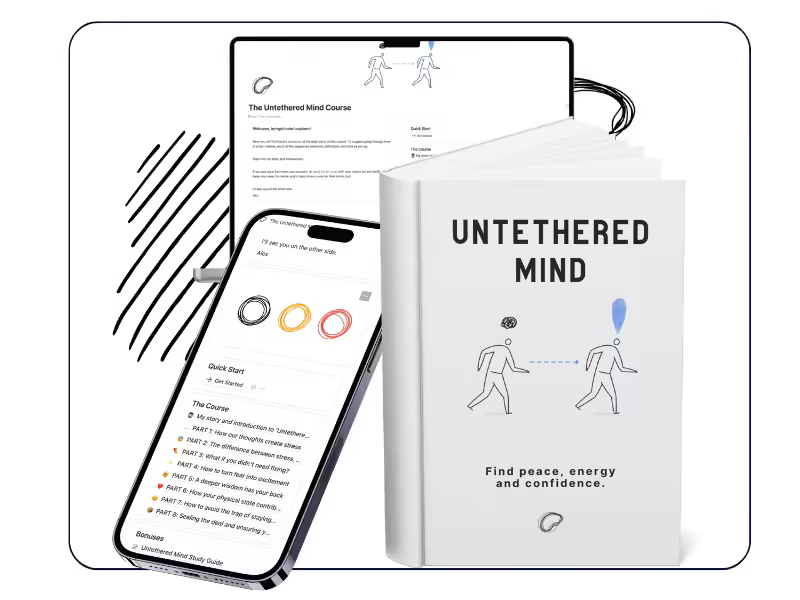
Learn more here and get access today.
And join us as a paying subscriber here for access to more bonuses and to support my writing:
Great gleanings to live by! For the past three years, I’ve startedmy mornings with the day’s lesson from Ryan Holiday’s The Daily Stoic book. Practicing and applying sage Stoic wisdoms has been life-changing. You’ve inspired me to read The Obstacle is The Way. Resiliency is such an underdeveloped superpower. We should be introducing this concept at a much younger age - with children when their minds and attitudes are still forming.
This is a BRILLIANT list and number 5 is the one I keep coming back to. I work in behaviour change and it's wild how much energy people burn on things they have zero influence over. Once you actually map out what's in your control vs what isn't, it's almost embarrassing how much time was going to the wrong column. Number 9 too, nothing puts a bad week in perspective faster! ;)