

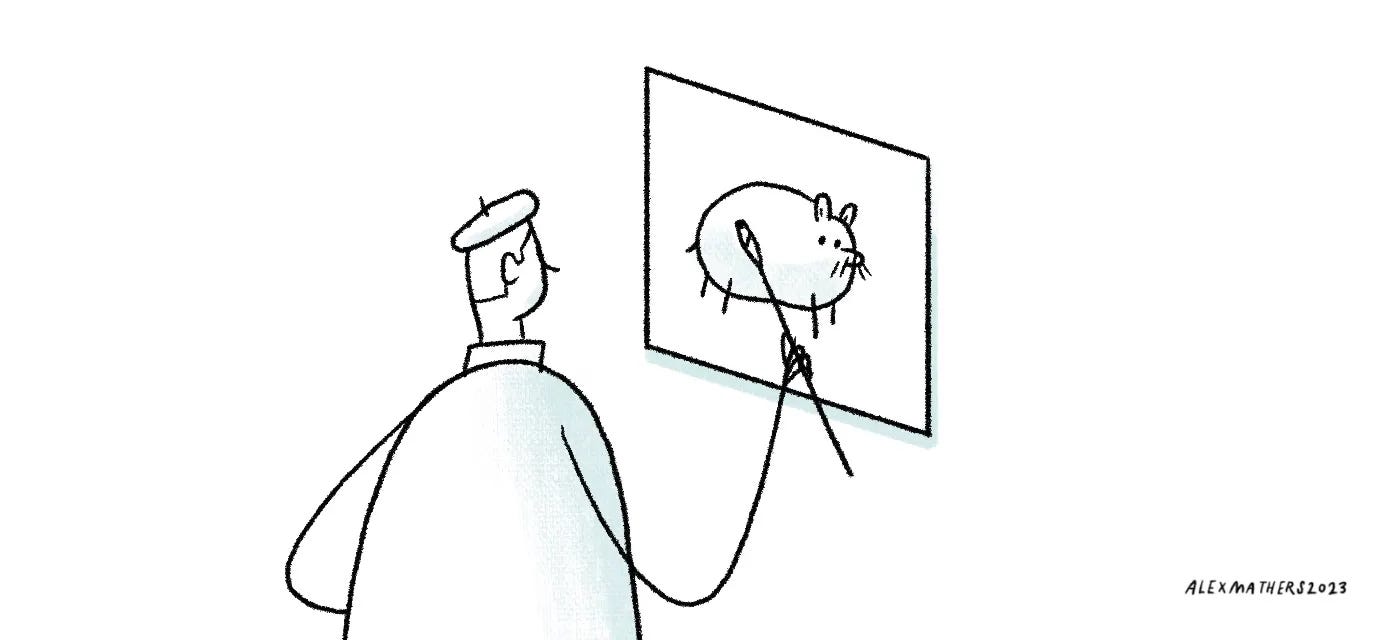
Hey Derek, do you ever get bored, mate?
Nah, mate! I have YouTube videos to escape to!
Good for you, mate!
Thanks, mate!
…
See Exhibit A above - a recent conversation with my mate Derek.
In 2007, Derek was a prolific artist.
He’d knock the socks off people with glorious paintings featuring hamsters dressed up like real people.
But somewhere along the way, Derek lost his spark and his enthusiasm for creating much at all.
Now he does ‘just enough’ at his data-entry job to pay the bills. But most of his day is filled with catching up on his favourite gaming channels and giggling through the latest TikTok reels.
Good old Derek is rarely bored, you see.
And neither are millions of people across the planet, who clock up over five hours per day on their magical dopamine dispensers - also known as “smartphones.”
‘We’re not bored!’ Millions cry in unison, setting off several mini-tsunamis.
Mark SugarMountain rubs his hands together, overjoyed at the lack of boredom he sees in the people who have joined his Tech Tribe, now fully immersed in his Metascape.
The trouble with fewer bored people is we have more deluded and soft-minded humans.
These people may have found a way to avoid boredom, but they’ve paid for it with their productivity and resilience.
When we respond to discomfort with a heady cocktail of dopamine-spiking stimulations, we reinforce the reality that we aren’t much good at handling perceived hardship.
So when tough things do happen:
We lose a pet parakeet to the bird flu;
The food takes ages to arrive;
Our smirking boss drops overtime work in our inbox;
A man says a mean thing to us in the street;
Our wi-fi signal drops to one bar;
Or we’re tasked with using our creative capacity to write an article.
...We struggle.
We self-medicate further with food, games, pixel boobs, dopamine fixes and trips abroad.
So, Alex, what are you saying we do?
How do we get out of this pickle?
My answer: be ok with feeling bored. At least sometimes.
Re-introduce windows of controlled ‘boredom’ back into your life.
The discomfort resilience muscle has atrophied, but it can be strengthened again.
There is an untapped opportunity here, especially in this mad, busy world.
The next time you feel bored, become curious about the physical experience of boredom.
Watching our sensations of boredom does a cool thing:
Our stale, bored thinking is replaced by fresh thinking.
And this often happens quickly.
The feeling of boredom melts away.
Many want to escape, but not you.
Come back here and wait for a moment, will you?
Watch the feeling, the bored thinking dissolves, and you feel better.
Try it now.
You may now be rewarded with an interesting idea or insight.
By doing this regularly, you have two things that set you apart:
You are training yourself NOT to escape when you’re uncomfortable. You literally become more mentally resilient.
You become a creativity engine. This is not an understatement. People will watch you in awe and wonder why you’re so damn productive, coming up with all these kick-ass ideas.
You know the secret.
While Jessie, Derek, Carlos and Umbebwe scrambled to Netflix at the first sign of boredom,
You held fast.
You nudged shoulders with your new friend, Boredom.
Boredom acknowledged your friendship and gave the gift it was dying to share.
That’s how you continue to win.
—
Thanks for reading.
Want to learn 25 other habits that build even greater life satisfaction?
I was never particularly happy until my late twenties. Things changed noticeably for me then. I learned ‘happiness’ is more to do with self-respect than anything else.
When I learned to move past my insecure thoughts and carve a healthy and confident self-identity, real, genuine satisfaction poured into my life. It was weird, but made sense.
Learn the 25 little daily habits I use that reinforce a powerful identity of self-respect in achievable daily steps.
My book shows you how (comes with 3 awesome bonuses):
Get the Art of Self Respect book bundle here.
“One of the best self-help books I’ve read in a long time. Alex exposes, in a clear and concise manner, the behaviors we should study, practice, and adopt to develop better self-respect. This, in turn, leads to earning respect from others.” - Jean Pierre
—
Brilliant yet again Alex!
I notice there's a lot of blame going toward social media, and "Ol Mr Mark." But I think the real issue runs deeper than that, it's about our own accountability. Let me flip it, contrarian-style.
Derek doesn't have to hold himself accountable because... maybe all his peers are on TikTok too, so why should he be the one to change? It's a dopamine system, designed to pull control away from him, so surely he's not really doing anything wrong. It's TikTok, YouTube, Mark's Metaverse — even though Mark doesn't actually control TikTok or YouTube or X, but anyway. I have to stay current or I lose touch. Everyone around me is doing the same thing.
So maybe Derek doesn't need to change anything. All the control sits with Apple, Meta, Google. Instead of asking Derek to do something, maybe we should just "bring down" the tech giants? Except that's not really possible. And where would Derek even learn how to cut back on social media — on social media, of course. Where do we preach about this? Also social media.
Maybe the problem sticks around until we're willing to look a little closer to home.
So how do you actually take on that kind of power? Simple in theory, just stop using it. If 20 million people stopped using Instagram for a day, it would struggle. But so would the small creators trying to make a living from it.
So what's the answer?
Maybe it's less about preaching that social media is ruining us, and more about learning to live with it well — adapting to it, even making peace with it. None of us are deleting it for good, so the more useful skill is accountability and control.
Take alcohol as a comparison. If I drink all day, my life falls apart, and people would fairly say I'd made a bad call. Alcohol is engineered to be moreish too, but we don't excuse heavy drinking by blaming "Big Alcohol" instead. Plenty of people drink responsibly, which is part of why we allow it in society despite its risks.
The same is true of social media. Plenty of people use it well: building businesses, connecting, teaching, supporting others. And some people make dopamine-chasing clickbait. So who's really the issue? Not the platform itself, but what gets made and what we choose to watch. Someone puts together a brilliant documentary series that could genuinely educate people, and yet because of the rubbish elsewhere, the instinct is to tear down the whole system.
It comes back to choices. Spend five hours a day scrolling, and there are consequences; but they're the result of choices, not fate.
It's worth noting that even the most serious addiction models agree with this balance.
- They hold two things at once: first, that addiction is genuinely hard to escape. There's a real vulnerability or disease element that makes it more than "just weak willpower."
- But second, that recovery is still built entirely on agency. Every major treatment approach; CBT, motivational interviewing, 12-step programs, puts the person's own choices at the centre of getting better.
Social media isn't so different. However, we're telling ourselves a narrative that makes it feel like it is.